New Zealand's inflatable stand-up paddle board (iSUP) market offers a clear commercial opening for Korean exporters: a 0% import tariff, no product licensing requirements, and a December–March peak season that inverts the Northern Hemisphere calendar — giving Korean producers lead time when global container demand is lower. Sourcing managers evaluate new suppliers on CE and REACH certification, double-layer drop-stitch construction quality, and price positioning inside the NZD $699–$999 mid-market band. A distribution partnership covering both NZ and Australia is typically the fastest route to volume that justifies a first container.
A Growing Market with Clear Seasonal Demand
The global stand-up paddleboard market was valued at USD 1.74 billion in 2026 and is projected to reach USD 2.74 billion by 2031, at a 9.45% compound annual growth rate (Mordor Intelligence). Inflatable SUPs dominate that market: they hold 60.25% of the global total in 2025 and grow faster than the overall category at 10.12% CAGR, driven by portability, compact storage, and a lower price-to-value ratio versus rigid boards (Mordor Intelligence).
New Zealand sits within the Asia-Pacific region — which Mordor Intelligence identifies as the fastest-growing SUP segment globally, projected at 9.48% CAGR through 2031. Australia and New Zealand are specifically cited as mature markets in this region, supported by strong coastal and lake participation. NZ also has institutional depth: NZSUP (New Zealand Stand Up Paddling) is the national governing body that organises annual race championships and SUP SAFE safety education programs. That kind of infrastructure signals sustained, year-round demand well beyond casual holiday use.
Global stand-up paddleboarding participation grew 19% between 2022 and 2024, driven by wellness tourism integration, fitness and yoga adoption on the water, and the sport's low barrier to entry for beginners (Verified Market Research). NZ reflects this same growth pattern across all activity types.
The Seasonal Import Window: Timing Is the Advantage
NZ Peak Season Order Deadline
Order Deadline for NZ Peak Season
NZ's summer paddling peak runs December–March. Place purchase orders August–October to clear customs and reach distributor warehouses before November. Orders placed after October typically miss the primary retail sell-in window and risk being held for the following season.
New Zealand's peak paddleboarding season is December through March (NZ Pocket Guide). North Island water temperatures during these months allow paddling without a wetsuit. South Island paddlers extend the season year-round with wetsuit gear, creating a secondary recurring demand segment.
For a sourcing manager or importer, the planning calendar is clear: orders placed August through October arrive before the December sell-in window. This period falls outside Northern Hemisphere holiday shipping surges, so container availability and lead times from Korean manufacturers are more predictable than during the global Q4 peak.
SUP board rental rates in NZ range from NZD $20–$50 per hour and NZD $50–$100 per day at tour and lesson operators (NZ Pocket Guide). Operators running high-volume daily rentals need boards that hold up across multiple seasons of hard use. Those same operators run introductory lessons that convert first-time renters into buyers — sustaining retail demand for mid-range consumer boards throughout the summer quarter.
Distribution Channels: How iSUPs Reach NZ Buyers
NZ's sporting goods retail landscape has moved decisively online. Torpedo7 — the country's largest outdoor gear retailer — closed its 20+ physical stores and now operates exclusively as an e-commerce platform. This reflects the broader post-pandemic shift from bricks-and-mortar to online purchasing for sporting goods in NZ (U.S. International Trade Administration).
Four distribution routes are relevant for a Korean iSUP supplier entering NZ:
Online-first national retailers (Torpedo7 and similar platforms) carry multiple SKUs, require strong product content and technical specifications, and expect reliable restock lead times. These platforms offer the fastest path to national consumer reach.
Specialty watersports and SUP retailers are smaller operators who carry a tighter product range but often also run lessons and rental fleets. They are open to both commercial-grade fleet boards and consumer SKUs, and tend to become long-term partners once product quality is established.
NZ-based direct-to-consumer brands like Moana SUP (Nelson) sell direct at NZD $699–$999 for mid-tier inflatables, positioned on local identity. A Korean supplier cannot compete on that local brand narrative, but can supply wholesale to distributors operating in the same price band.
Rental fleet and tour operators buy in bulk for commercial use and prioritise durability over aesthetics. Double-layer drop-stitch construction and heat-welded seams are standard requirements at this tier. A 1,000-unit MOQ aligns well with typical fleet refresh volumes.
What NZ Buyers Expect from a New Supplier
Double-Layer vs Single-Layer Drop-Stitch: Key Differences
| Double-Layer Drop-Stitch | Single-Layer Drop-Stitch | |
|---|---|---|
| Board stiffness | 40% greater rigidity | Standard baseline |
| Max rated PSI | 15–20 PSI | 10–15 PSI typical |
| Commercial rental suitability | Yes — handles repeated inflation cycles | Entry-level use only |
| Price positioning | Mid to high-end band | Entry-level band |
| PVC thickness (commercial) | Min 1.2mm military-grade | Below 1.2mm typical |
NZ importers and distributors evaluate overseas suppliers on brand recognition, price competitiveness, durability, design, and — increasingly — sustainability (U.S. International Trade Administration). For a supplier entering NZ without an established brand, the non-brand criteria must carry the evaluation.
Certifications as compliance evidence — NZ has no mandatory product safety standard specifically for inflatable watersports equipment. The mandatory NZ product standards cover children's products, bicycles, ladders, lighters, and sunscreen — not inflatables (Product Safety New Zealand). However, all goods sold in NZ must be safe under the Consumer Guarantees Act 1993 and the Fair Trading Act 1986. In practice, importers use international certifications as their compliance documentation:
- CE marking (EN ISO 6185-4:2018): covers structural safety for inflatable craft; required by major global retailers and used as a manufacturing quality benchmark by NZ buyers
- ISO 25649-1:2017: sets material and labeling requirements for floating leisure articles including iSUPs; widely required by quality-conscious international buyers (ISO)
- REACH compliance: chemical safety for PVC materials covering phthalates, lead, and cadmium; NZ importers accept SGS or TÜV test reports as proof
- BSCI or SMETA: social compliance audits required by major retail chains such as Decathlon; increasingly expected by larger NZ retail accounts
According to Huale Inflatable, the four certifications NZ and global importers consistently require from a reliable iSUP manufacturer are: ISO 9001 for quality management and batch consistency, REACH for chemical safety, CE marking for structural safety, and BSCI or SMETA for social compliance.
Construction quality benchmarks — sourcing managers look at specific technical markers. Per RideWave SUP, the key indicators are: drop-stitch fabric density of 500D–1,000D (higher density means greater board stiffness), minimum 1.2mm military-grade PVC thickness for rental and commercial applications, heat-welded seams for pressure retention superior to glued bonding, and a maximum rated inflation pressure of 15–20 PSI. A board rated at 15 PSI with double-layer drop-stitch construction meets or exceeds the technical floor for both commercial fleet and mid-market consumer use.
Price Positioning in the NZ Market
Global iSUP retail price segmentation (USD): entry-level around $450 for a basic board bundle with aluminum paddle, mid-range $500–$1,200+ for tested performance boards, and a high-end tier above $1,200 for established brands offering warranties up to five years (Inflatable Boarder).
In NZ, Moana SUP's NZD $699–$999 range marks the active mid-market band for a locally branded direct-to-consumer supplier. For a Korean supplier, the import cost structure supports competitive pricing in this band. NZ applies a 0% import tariff on most sports equipment under HS 9506, with a flat 15% GST on the CIF value (U.S. International Trade Administration). No import licensing is required.
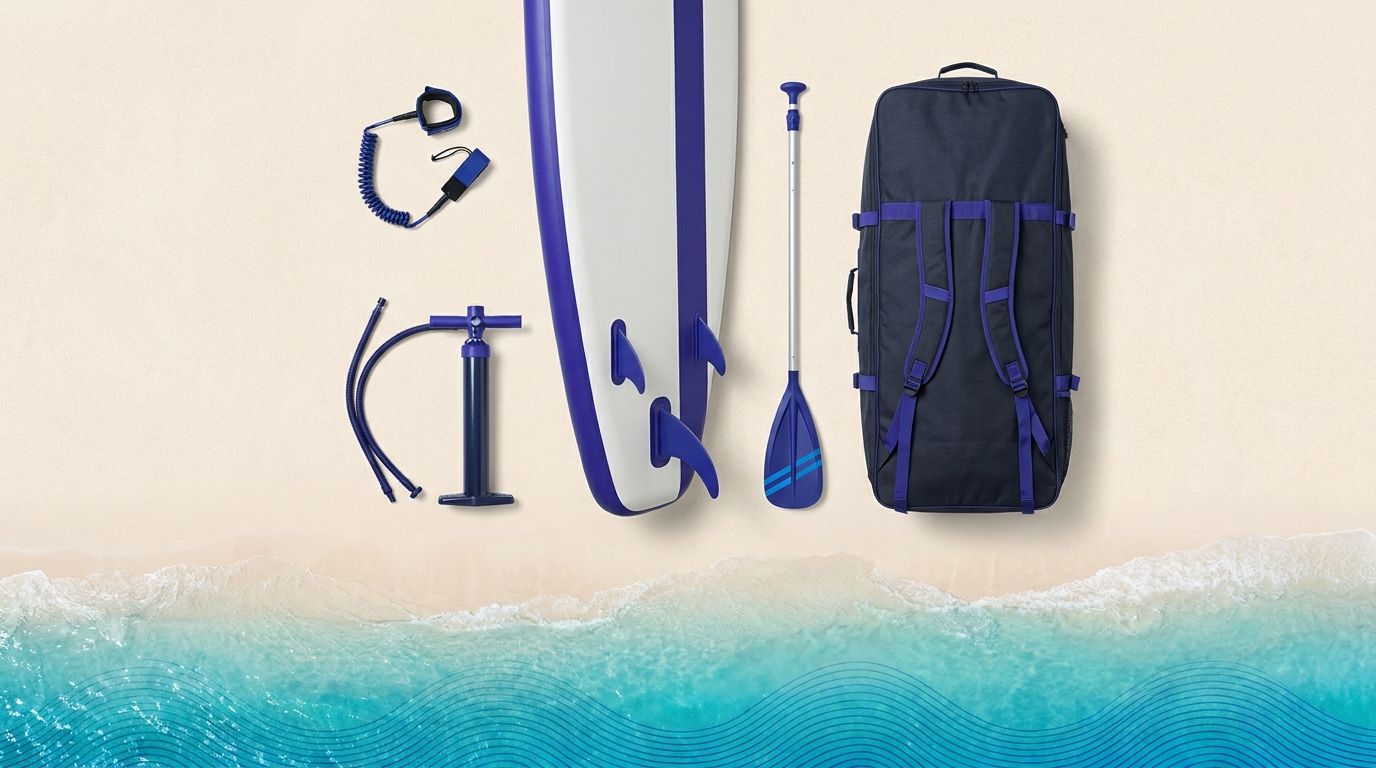
A complete bundle — board, aluminum paddle, manual pump, ankle leash, 27-litre backpack case — at a 1,000-unit MOQ gives a wholesale buyer room to price at NZD $699–$849 retail while maintaining distribution margins, depending on freight cost per unit and the NZD/KRW exchange rate at the time of shipment.
Import Mechanics: Getting Boards into NZ
NZ Importer Documentation Checklist
- CE Declaration of Conformity (EN ISO 6185-4:2018)Structural safety for inflatable craft — minimum floor for most NZ retail and online buyers
- ISO 25649-1:2017 compliance documentationMaterial and labeling requirements for floating leisure articles including iSUPs
- REACH test report from SGS or TÜVChemical safety for PVC (phthalates, lead, cadmium) — must be ISO 17025-accredited lab
- Commercial invoice, packing list, bill of ladingStandard NZ import documentation set; confirm HS 950699 with customs broker first
- BSCI or SMETA social audit certificateRequired by Decathlon and major NZ retail chain buyers
For HS 950699 (inflatable paddle boards under the sports equipment heading), the key import facts are: 0% tariff on CIF value, 15% GST on CIF value, no import license required, and mandatory metric product labeling (U.S. International Trade Administration). Incorrect HS code classification can trigger NZ Customs penalties of up to 200% of evaded duties, and all test certificates must come from an ISO 17025-accredited laboratory (FreightAmigo). Importers should confirm the HS sub-heading with a licensed customs broker before the first shipment.
The documentation set a NZ importer will typically request includes: commercial invoice, packing list, bill of lading, CE declaration of conformity, REACH test report from an ISO 17025-accredited lab, and — for major retail chain buyers — a BSCI or SMETA social audit certificate.
NZ Alone or as an Oceania Gateway?
For a Korean supplier with a 1,000-unit MOQ and 50,000-unit monthly capacity, NZ alone may not fill a full container on the first order without a committed distribution partner. NZ's total Sport and Camping Equipment market was approximately NZD $2.2 billion in 2024 (IBISWorld) — structurally solid, though the iSUP sub-category is a small fraction of that total.
The more commercially useful framing is NZ as the anchor for an Oceania distribution arrangement. Many NZ importers also source for the Australian market, and the Trans-Tasman trade relationship makes dual-market supply practical. Australia and NZ share broadly similar certification expectations — CE, REACH, ISO — and the same Southern Hemisphere seasonal window. A Korean supplier that can service both markets in consolidated shipments is in a materially stronger position with a NZ-based importer than one pitching NZ as a standalone territory.
Asia-Pacific is already the fastest-growing SUP region globally (Mordor Intelligence), and NZ and Australia represent the two most commercially established markets within it. Entering through NZ — with the right distribution partner — positions a Korean iSUP supplier to expand into the broader Oceania channel as product-quality and reliability are established over the first two seasons.
Frequently Asked Questions
What certifications should an inflatable paddle board carry for sale in the New Zealand market?
NZ has no mandatory iSUP-specific safety standard. All goods must be safe under the Consumer Guarantees Act 1993 and Fair Trading Act 1986. In practice, NZ importers use international certifications as their compliance evidence: CE marking (EN ISO 6185-4:2018) for structural integrity of inflatable craft, ISO 25649-1:2017 for floating leisure article safety and labeling, REACH compliance for PVC chemical safety (phthalates, lead, cadmium), and BSCI or SMETA social audits for major retail chain buyers. Per Product Safety New Zealand, test certificates must be from an ISO 17025-accredited laboratory.
What is the optimal ordering timeline to import SUP boards from Korea for the NZ peak season?
NZ's paddleboarding peak runs December through March (NZ Pocket Guide). To receive stock before the December sell-in window, importers should place purchase orders August through October. This avoids Northern Hemisphere holiday shipping surges and results in more predictable container lead times from Korean manufacturers.
How does double-layer drop-stitch PVC compare to single-layer construction for commercial rental fleets and resale?
Double-layer drop-stitch construction delivers approximately 40% greater board stiffness versus single-layer alternatives and handles repeated high-pressure inflation cycles better in commercial rental environments. For resale, it supports a higher retail price point and gives distributors a clear differentiation argument when competing against entry-level single-layer boards at similar pricing. Per RideWave SUP, minimum 1.2mm military-grade PVC with heat-welded seams is the commercial rental floor.
What import duties, GST, and compliance documentation apply to inflatable paddle boards entering New Zealand?
NZ applies a 0% import tariff on most sports equipment under HS 9506 (confirm sub-heading 950699 with a licensed customs broker). A flat 15% GST is charged on the CIF value. No import license is required. Product labeling must use metric measurements. Core documentation includes: commercial invoice, packing list, bill of lading, CE declaration of conformity, and REACH test report from an ISO 17025-accredited lab. Per FreightAmigo, incorrect HS classification can trigger penalties of up to 200% of evaded duties.
At what NZD price point can a Korean-sourced iSUP realistically compete against established brands and local suppliers like Moana?
The active mid-market band in NZ is NZD $699–$999, anchored by brands like Moana SUP. A Korean-sourced iSUP with double-layer construction, a full accessories bundle (board, aluminum paddle, pump, ankle leash, backpack case), and CE/REACH documentation can be positioned at NZD $699–$849 retail while maintaining wholesale distribution margins, subject to freight cost per unit and the NZD/KRW exchange rate at the time of shipment (Inflatable Boarder pricing reference).