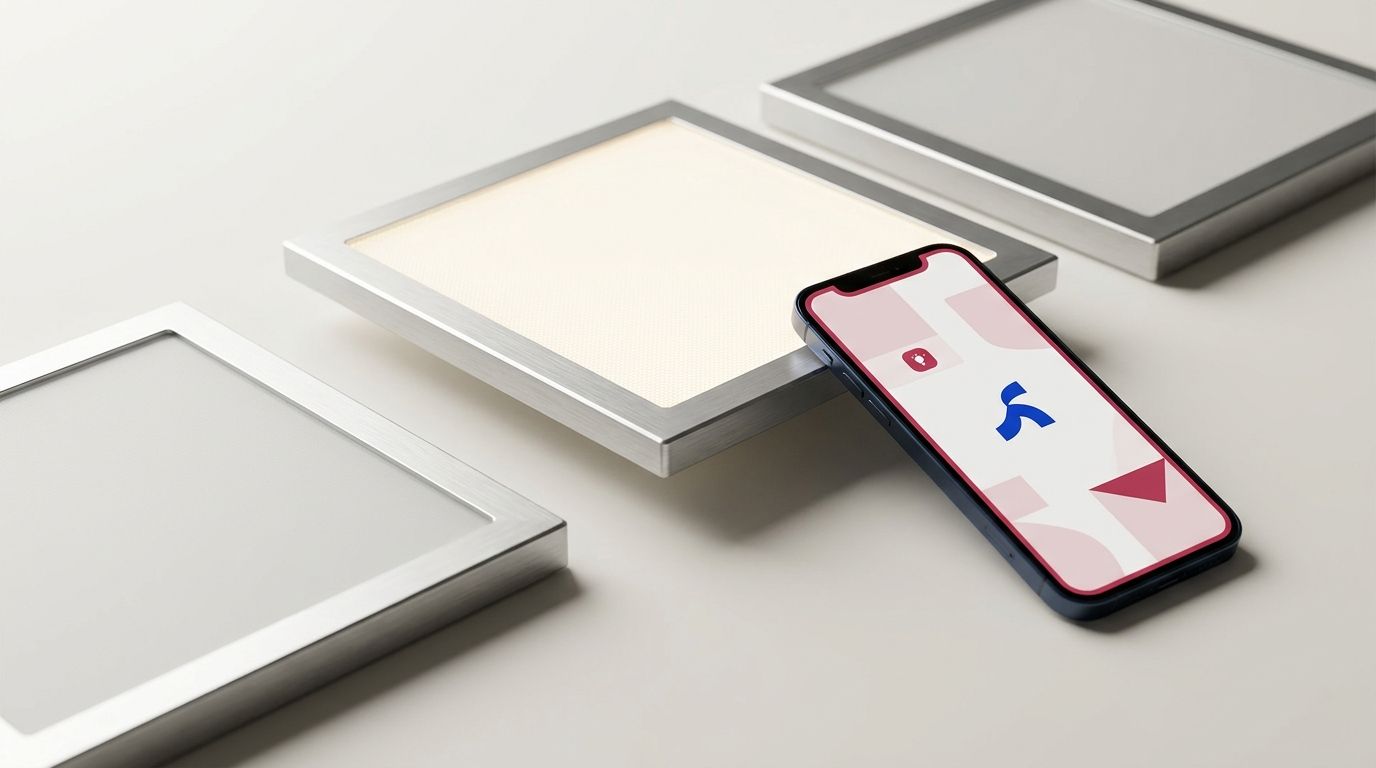
Importing a Korean 40W smart LED panel light into Japan carries zero customs duty under HS 9405.11, but sourcing managers must budget for a 10% Japan Consumption Tax (JCT) on the CIF import value, a one-time Diamond PSE certification fee of USD 5,000–6,500 per product model, and Giteki wireless type-approval costs of USD 9,000–20,000 for smart panels with integrated Wi-Fi or Bluetooth. This guide builds the full landed-cost stack — freight, taxes, compliance amortisation, and channel margin benchmarks — so you can test whether a Korean smart LED supplier achieves the 25–35% gross margin that Japan's commercial lighting distribution economics require.
Japan's LED Panel Market — and Why the Economics Matter Now
Japan's smart lighting market was valued at USD 1,331.3 million in 2025 and is projected to grow at a CAGR of 17.09% through 2034, reaching USD 5,507.3 million, according to IMARC Group. LED panel lights are the largest single product segment at 30% market share, driven by commercial offices, retail spaces, and healthcare facilities demanding uniform illumination with IoT control. The commercial end-use sector alone represents 40% of market demand. Critically: 52% of Japan's LED supply already comes from overseas manufacturers, meaning the import channel is structurally open (IMARC Group, Japan Smart Lighting Market Report 2025).
Japan's broader LED fixtures market generated USD 3,428.6 million in revenue in 2024 and is expected to reach USD 5,150.0 million by 2030, per Mordor Intelligence. For a Japanese lighting distributor, the market opportunity is not in question. The question is whether the landed-cost economics work after duty, consumption tax, and compliance fees.
Building Your Landed-Cost Stack
Start with CIF — the taxable base. Japan assesses all import duties and taxes on the CIF (Cost, Insurance, Freight) customs value: the product price plus all charges incurred to transport and insure goods to the Japanese port of entry, per the U.S. International Trade Administration's Japan Country Commercial Guide. Freight and insurance on the Korea-to-Japan leg are part of your taxable customs base, not merely a logistics line item.
Customs duty: zero. Japan's 2026 tariff schedule lists HS 9405.11 (luminaires and lighting fittings designed solely for LED light sources) at 0%—Free—across every tariff column: MFN, Temporary, WTO Bound, RCEP, EU EPA, CPTPP, and the Japan-US Trade Agreement, per Japan Customs' official tariff data. South Korea's RCEP membership makes no practical difference here because the MFN rate is already zero from all origins. Korean smart LED panel exports to Japan face zero import duty.
Japan Consumption Tax (JCT): 10% of CIF. JCT is levied at the border at 10% of the CIF customs value plus applicable duty, per ACP Japan (a licensed Japan IOR specialist). Since HS 9405.11 duty is 0%, the formula simplifies to JCT = 10% × CIF value. For a USD 30 FOB unit with USD 3 of freight and insurance, the CIF value is USD 33 and JCT at clearance is USD 3.30 per unit. The important distinction: JCT paid at import is recoverable as an input tax credit by a Japanese registered importer within the domestic consumption tax system. It is a working-capital cost at customs clearance, not a permanent margin reduction.
Brokerage and domestic logistics. Primary sourced figures for Japan customs brokerage fees and per-unit domestic logistics costs were not confirmed from official fee schedules and are excluded here. Your Japan licensed customs broker will provide a declaration fee estimate; domestic forwarding costs should be sourced from your logistics partner for the specific commercial LED fixture specification.
Compliance Costs: Diamond PSE and Giteki Certification
This is where smart LED economics diverge from commodity LED lamps — and where Korean suppliers can create a durable competitive advantage through pre-certification.
Diamond PSE (DENAN). Japan's Electrical Appliance and Material Safety Law (DENAN / 電気用品安全法) designates AC-mains-powered LED luminaires as Specified Electrical Appliances, requiring a Diamond PSE mark and third-party conformity assessment by a METI-registered testing body before import or sale. Testing is conducted against Japanese Industrial Standards (JIS J 60598-1, J 61347-1, J 61347-2-13, and J 55015 for radio-disturbance limits), per Meide Testing Technology. The exporter's existing CE, RoHS, or UL certifications carry no direct mutual recognition in Japan — fresh JIS-standard testing is required. However, a valid CB (IEC) test report can reduce re-testing scope, shortening the process from 6–8 weeks to 4–6 weeks. Cost: USD 5,000–6,500 per SKU, based on published examples from Japan PSE certification providers (JJR Lab EMC Testing).
Giteki / MIC Radio Law. Smart LED panels with integrated Wi-Fi, Bluetooth, or Zigbee modules require a separate Giteki certification (技適マーク) from a Ministry of Internal Affairs and Communications Registered Certification Body — completely independent of PSE. Per JJR Test Lab (IEC 17025 accredited EMC/RF testing laboratory, Giteki Certification Cost Guide 2025), total Giteki costs range USD 9,000–20,000 across three components: (1) RF and EMC testing fees USD 5,000–10,000 (wireless products carry higher testing costs than wired due to multi-protocol RF testing); (2) agent service fees USD 3,000–6,000 covering document submission, MIC communication, and annual maintenance; (3) official MIC application fees USD 1,200–2,000 depending on product complexity. These figures are indicative — obtain a formal quote from a Japan MIC Registered Certification Body before budgeting, as complex multi-band devices may exceed USD 20,000. Timeline: 8–12 weeks standard (testing 1.5–2 months, MIC review 2–4 weeks); expedited service at a 30–50% fee premium can compress total cycle to 6–8 weeks. One shortcut worth checking: if the Korean manufacturer's wireless chipset already holds a Giteki number (common for widely-used MediaTek, Qualcomm, or Nordic chipsets), the importer may be able to leverage that existing certification rather than running a full application.
Top Runner Programme. LED lamps are a designated Top Runner product under Japan's Energy Conservation Act (METI, per WTO TBT submission). Products must meet efficiency thresholds and be tested in METI-registered laboratories. A 40W smart panel producing 4,400 lm (110 lm/W) typically exceeds threshold requirements for this category, but importers must confirm model compliance and may need Japanese lab test reports before legal sale.
Amortizing Compliance Costs at MOQ Scale
The one-time nature of PSE and Giteki certification is both a barrier and a moat. Once paid, those costs are sunk — subsequent shipments carry zero incremental compliance cost unless the product specification changes.
At a first shipment of 1,000 units (the stated MOQ for this smart LED panel programme):
- PSE cost amortised: USD 5,000–6,500 ÷ 1,000 = USD 5.00–6.50 per unit
- Giteki cost amortised: USD 9,000–20,000 ÷ 1,000 = USD 9.00–20.00 per unit
Combined first-shipment compliance overhead: USD 14.00–26.50 per unit. This is significant against a typical mid-range smart panel landed cost and compresses first-order margins. At 5,000 cumulative units shipped, the per-unit amortisation drops to USD 2.80–5.30 — well within the margin available on smart LED lines. The break-even calculation is why early-stage market entry and trial orders need to be structured carefully: either the Korean supplier shares certification costs, or the commitment covers sufficient volume to absorb the overhead.
Where Korean Supply Beats China in Japan
Korean vs. China-Sourced Smart LED Panels: Japan Market Comparison
| Korean Supply | China Supply | |
|---|---|---|
| Japan customs duty (HS 9405.11) | 0% — MFN and RCEP | 0% — MFN only |
| 2024 avg. import unit value (LED lamps) | USD 1.70 / unit (IndexBox 2024) | USD 3.70 / unit (IndexBox 2024) |
| Ocean transit time to Japan | ~2 days (Busan–Tokyo short-sea) | 3–7 days (Shanghai / Shenzhen–Tokyo) |
| CB test report for PSE leverage | Yes — reduces re-testing scope and timeline | Varies — fewer JIS-aligned test bodies |
| OEM customisation at low MOQ | MOQ 1,000 pcs; rapid sample turnaround | Typically higher MOQ; longer sample lead time |
South Korea ranked as Japan's second-largest LED lamp supplier by volume in 2024, shipping 4.4 million units valued at USD 7.6 million, with an average unit value of USD 1.70 — compared to China's average of USD 3.70 per unit, according to IndexBox (Japan LED Lamp Import Statistics 2024). At the commodity end, Korea enters Japan at less than half the Chinese unit price.
For smart LED panels specifically, the Korean structural advantage is more nuanced. Shorter ocean transit of approximately 2 days (Busan to Tokyo) versus 3–7 days from Chinese manufacturing hubs reduces both inventory-in-transit costs and the risk of urgent re-orders due to shipping delays. CB test report documentation — which Korean manufacturers often hold for EU and US certifications — reduces PSE testing scope and can meaningfully cut both cost and timeline. Lower MOQ flexibility at 1,000 units per order enables faster range testing before committing to larger volumes, compared to the higher MOQ norms that often apply to Chinese LED panel OEMs.
Four Cost Traps That Quietly Erode Margin
Four Cost Traps That Quietly Erode Importer Margin
Four Cost Traps That Quietly Erode Importer Margin
HS code mislabelling (e.g., 9405.40 instead of 9405.11), PSE re-certification triggered by mid-run spec changes, shipping 220V-rated panels into Japan's 100V grid, and failing Top Runner efficiency thresholds are the four most common margin killers for LED luminaire importers. Each incident can cost USD 5,000–20,000 and 2–8 weeks of delay.
Four specific failures account for most margin erosion in Japan LED luminaire imports:
1. HS code mislabelling. Classifying a smart LED panel under 9405.40 (other luminaires) or another sub-heading instead of 9405.11 (luminaires for LED light sources) can trigger customs clearance delays and duty re-assessments. Confirm the correct heading with your Japan-licensed customs broker before the first shipment.
2. PSE re-certification on spec changes. Any modification to the power supply, LED driver, or wireless module — even a component substitute from an alternate vendor — may require a new Diamond PSE application. Lock specifications before certification begins and maintain a change-control process with your Korean supplier.
3. Voltage and frequency mismatch. Japan operates at 100V AC — eastern Japan at 50 Hz, western Japan at 60 Hz. A smart LED panel rated at 220–240V input is non-compliant and cannot be legally sold. Confirm 100V input compatibility with the Korean manufacturer before placing a production order.
4. Top Runner compliance gaps. A luminaire that fails to meet METI efficiency thresholds under the Top Runner Programme cannot be legally sold in Japan. Costly re-testing or product withdrawal is the result. Confirm your model's lm/W rating against the current threshold for the relevant luminaire sub-category.
Target Gross Margin for Smart LED Panel Distribution
Smart and feature-rich LED panels with integrated IoT control achieve 25–35% gross margins in the distribution channel, versus 18–25% for standard commodity LED panels, according to LIBULBS (LED Lighting Distributor Profit Margins 2026). Operating margins for smart LED proprietary product lines run 12–18%. Commodity-end panel margins face ongoing pressure from 40% price declines over five years and online price transparency.
For a Japanese distributor importing Korean smart LED panels, the 25–35% gross margin target is achievable at B2B resale pricing that reflects the product's IoT control features, energy efficiency class A++ rating, 50,000-hour rated life, and smartphone and voice-assistant control capability. The compliance overhead — PSE and Giteki — is a one-time investment that creates a product-level barrier to competitive substitution once established.
Last updated: 2026-06. The cost figures, certification requirements, and regulatory information in this guide are for reference and modelling purposes only. Import regulations, certification fees, tariff schedules, and market conditions change. Always confirm current requirements with a licensed Japan customs broker, a METI-approved testing body, and qualified local regulatory consultants before committing to a sourcing programme or production order.
Frequently Asked Questions
- Do I need both Diamond PSE and Giteki certification for a smart LED panel with built-in Wi-Fi and Bluetooth?
- Yes — both are legally required and are completely separate certifications. Diamond PSE (administered by METI under DENAN) covers electrical safety for the AC-mains-powered luminaire. Giteki (administered by MIC under the Radio Law) covers the wireless radio module. They are independent processes with different testing bodies, different standards, and different timelines. Products without the Diamond PSE mark cannot legally be imported or sold in Japan. Products with an unlicensed radio device violate Japan's Radio Law.
- Is the HS 9405.11 customs duty really zero for Korean exports to Japan?
- Yes. Japan's January 2026 official tariff schedule lists HS 9405.11 at 0%—Free—for all origins, under both the general MFN rate and every preferential rate, including RCEP (which covers South Korea). There is no separate bilateral Japan-Korea EPA beyond RCEP, but the practical effect is the same: zero duty from all origins for this HS heading. Confirm the correct heading with your Japan customs broker before the first shipment — mislabelling to an adjacent sub-heading can change the outcome.
- Is the 10% Japan Consumption Tax a permanent margin cost or can it be reclaimed?
- JCT paid at import clearance is not a permanent margin cost. A Japanese registered importer can claim it as an input tax credit within the domestic JCT system, effectively recovering the tax through the domestic sales chain. It is a cash-flow cost at customs clearance — the JCT must be funded at the time of import declaration. The practical implication is a working-capital requirement, not a permanent landed-cost addition. Size the cash requirement as 10% of your CIF value per shipment.
- How much does Diamond PSE certification cost, and does my Korean supplier's CE report help?
- Diamond PSE certification for AC-powered LED luminaires costs approximately USD 5,000–6,500 per SKU, with a standard timeline of 6–8 weeks, per JJR Lab EMC Testing. If the Korean manufacturer holds a valid CB (IEC) test report — generated for CE or UL certification — a Japanese testing body can leverage it to reduce re-testing scope, shortening the timeline to 4–6 weeks and potentially reducing testing fees. The certification itself cannot be bypassed; fresh JIS-standard testing is required regardless of the CE or UL status.
- What are the most common cost traps that erode margin when importing Korean LED panels into Japan?
- The four most common are: (1) HS code mislabelling causing customs clearance issues, (2) PSE re-certification triggered by any mid-run specification change (power supply, driver, wireless chipset), (3) voltage incompatibility — Japan's 100V AC grid is not compatible with 220–240V-rated units, and (4) failing Top Runner energy efficiency thresholds, which blocks legal sales and requires costly remediation. Each can cost USD 5,000–20,000 and 2–8 weeks of delay, silently eroding margin on what otherwise appears to be a clean landed-cost model.
This information is provided for reference and modelling purposes only. Import regulations, certification fees, tariff schedules, and market conditions change. Always confirm current requirements with a licensed Japan customs broker, a METI-approved testing body, and qualified local regulatory consultants before committing to a sourcing programme or production order.
References
- Japan Customs, Ministry of Finance — Official Tariff Schedule as of 1 January 2026: HS 9405.11 at 0% (Free) across all tariff columns including MFN, RCEP, CPTPP, EU EPA, and Japan-US Trade Agreement
- ACP Japan (Japan IOR specialist) — Japan Consumption Tax (JCT) of 10% levied on CIF value plus applicable customs duty at import clearance; JCT recoverable as input tax credit by registered Japanese importer
- U.S. International Trade Administration (Japan Country Commercial Guide) — Japan assesses import duties on CIF customs value: product price plus freight and insurance charges to Japanese port of entry
- IMARC Group (Japan Smart Lighting Market Report 2025) — Market valued at USD 1,331.3M in 2025; CAGR 17.09% through 2034; LED panel lights 30% market share; commercial sector 40% demand; 52% of supply from imports
- Mordor Intelligence (Japan LED Lighting Market Report) — Japan LED fixtures market USD 3,428.6M in 2024; expected USD 5,150.0M by 2030; CAGR 7.5% (2025–2030)
- IndexBox (Japan LED Lamp Import Statistics 2024) — South Korea second-largest supplier by volume: 4.4M units at USD 7.6M; avg. unit value USD 1.70 vs. China's USD 3.70; China holds 92% of import value share
- Meide Testing Technology Co. — LED luminaires under DENAN require Diamond PSE certification; testing against JIS J 60598-1, J 61347-1, J 61347-2-13, J 55015; METI factory registration required before import or sale
- JJR Lab EMC Testing (Japan PSE Certification Cost Guide) — Diamond PSE cost USD 5,000–6,500 per SKU; 6–8 weeks standard; 4–6 weeks if CB (IEC) test report available from Korean manufacturer
- JJR Test Lab (IEC 17025 accredited EMC/RF testing laboratory — Giteki Certification Cost Guide 2025): total cost USD 9,000–20,000; testing fees USD 5,000–10,000 + agent service fees USD 3,000–6,000 + MIC application fees USD 1,200–2,000; standard timeline 8–12 weeks; expedited 6–8 weeks at 30–50% fee premium
- LIBULBS (LED Lighting Distributor Profit Margins 2026) — Smart IoT LED panels: 25–35% gross margins; standard commodity panels: 18–25%; smart proprietary lines operating margins 12–18%
- World Trade Organization (Japan TBT submission) — Top Runner Programme under Japan Energy Conservation Act: LED lamps designated target products; efficiency thresholds mandatory; METI-registered laboratory testing required
- Japan METI — Electrical Appliance and Material Safety Act (DENAN): AC-mains LED luminaires classified as Specified Electrical Appliances; Diamond PSE mark and METI factory registration required before import or sale