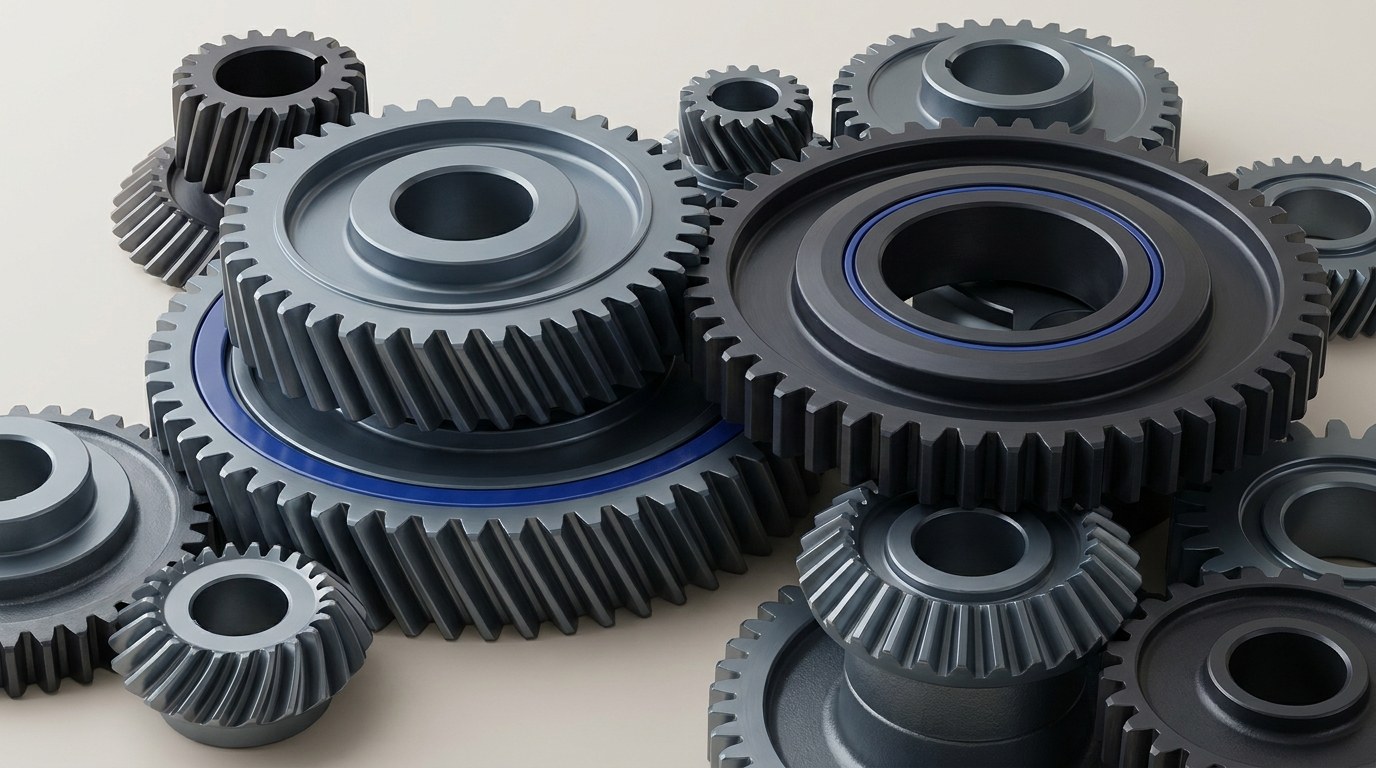
To export an Industrial Precision Gear Set from Korea into Germany, you do not need a product-specific German import licence, but you must prove originating status for the EU-Korea FTA, supply the standard customs document set, and hand over the quality and material certificates German buyers expect. Whether the part needs any CE documentation depends on whether it is treated as a plain component or as "partly completed machinery." This guide maps the certifications, the EU-Korea FTA origin declaration, and the document pack from your Korean factory to German customs clearance.
If you make precision gears in Korea and want to sell into Germany, the difficulty is rarely the part — it is assembling the right proof in the right order. Germany sits inside the EU customs union, so you are meeting EU rules, claiming a free-trade tariff, and building a documentation trail that has to be ready before the goods reach the port. The sections below walk through whether any special approval applies, how to unlock zero duty, the CE question, the certificates buyers expect, material and chemical compliance, and the document pack you build at the factory.
Do Industrial Precision Gear Sets Need Special Approval to Enter Germany?
There is no product-specific import licence for plain industrial gears entering Germany. They move as standard industrial goods governed by EU customs procedure, preferential origin rules, and the EU's horizontal product law — machinery rules, REACH, and RoHS where relevant. According to the European Commission's Access2Markets guidance, every EU import requires at minimum a customs declaration, a commercial invoice, a packing list, and a transport document, with product-specific items such as a certificate or declaration of origin added on top.
The correct starting point is classification. HS subheading 8483.40 covers gears and gearing, ball or roller screws, and gear boxes and other speed changers, so an industrial precision gear set falls on that line. Getting the HS code right matters because it sets the duty the origin declaration then reduces, and it keeps the description on your invoice consistent with the goods customs inspect. The work here is less about asking permission and more about preparing evidence.
The EU-Korea FTA Origin Declaration That Unlocks Zero Duty
The most valuable single document for a Korean gear exporter is the origin declaration. According to EUR-Lex and the European Commission, the EU-South Korea Free Trade Agreement has applied provisionally since 1 July 2011 and formally entered into force on 13 December 2015, eliminating customs duties on nearly all industrial goods traded between the EU and South Korea; the remaining industrial-product duties were fully phased out by 1 July 2016. In practice, an originating Korean gear set can enter Germany at 0% preferential duty — but only if you can prove that origin.
To claim the preference, the European Commission's rules-of-origin guidance explains, the exporter makes out an "origin declaration" on the commercial invoice. For consignments valued up to EUR 6,000, any exporter may issue it; above EUR 6,000, the exporter must hold an "approved exporter" authorisation number. The declaration is valid for 12 months from the date it is made out, and the exporter must keep a copy and all records proving originating status for at least five years. If your shipments routinely cross the EUR 6,000 line, secure approved-exporter status early so it never becomes the step that holds up a container.
The documentation path from your Korean factory to German customs
- 1
Classify under HS 8483.40
Fix the gear's HS subheading first; it sets the duty line German customs applies.
- 2
Prove originating status
Make out the EU-Korea FTA origin declaration on the commercial invoice — add an approved-exporter number if the consignment exceeds EUR 6,000.
- 3
Assemble quality and material proof
Gather the current ISO 9001 / IATF 16949 certificate reference and an EN 10204 3.1 material certificate per batch.
- 4
Settle machinery and chemical position
Confirm component vs partly completed machinery, and check REACH SVHC and RoHS applicability for the end use.
- 5
Build the customs document pack
Add the customs declaration, commercial invoice, packing list and transport document, then clear German customs at preferential duty.
Is a Gear Set CE-Marked? Component vs Partly Completed Machinery
Buyers frequently ask whether a bare gear set needs CE marking. Because a gear cannot perform a function on its own, it is usually not CE-marked as machinery. Under the new Machinery Regulation (EU) 2023/1230 — published on 14 June 2023 and applying from 20 January 2027, when it replaces Machinery Directive 2006/42/EC — the relevant category is "partly completed machinery." Per EU-OSHA, that is an assembly which is not yet machinery because it cannot in itself perform a specific application and is only intended to be incorporated into or assembled with other machinery.
The practical consequence is in the paperwork. Per EU-OSHA, partly completed machinery is not CE-marked as machinery, but it must meet the relevant essential health and safety requirements set out in the regulation, and it travels with a declaration of incorporation and assembly instructions rather than a full machinery Declaration of Conformity. A plain replacement gear and a sub-assembly supplied as partly completed machinery therefore carry different documents, so confirm with your German buyer how they classify your part before the first order.
Plain component vs partly completed machinery
| Plain gear component | Partly completed machinery | |
|---|---|---|
| CE-marked as machinery | No — a gear cannot perform a function by itself | No — not CE-marked as machinery either |
| Governing rule | Customs, origin, plus REACH/RoHS where applicable | Regulation (EU) 2023/1230 essential health and safety requirements |
| Travels with | Invoice, origin declaration, material certificate | The above plus a declaration of incorporation and assembly instructions |
| How it is decided | Classification confirmed with the German buyer | Classification confirmed with the German buyer |
Quality Certifications German Buyers Expect From a Korean Gear Supplier
German and EU OEM and Tier-1 buyers of precision gears typically expect a recognised quality-management certificate. ISO 9001 is the baseline; for automotive work, buyers ask for IATF 16949. There is an important update to get right here. According to ISO, IATF 16949:2016 was published on 3 October 2016 and cancelled and replaced ISO/TS 16949, and after 1 October 2017 certification audits could no longer be conducted to ISO/TS 16949. IATF 16949 is implemented as a supplement to, and in conjunction with, ISO 9001:2015, not as a standalone standard.
This matters for how you present your factory. If your documentation still reads "TS 16949," treat it as outdated and confirm the current certificate before you put any quality claim in front of a buyer. Stating a certification you cannot evidence is one of the quickest ways to lose a German account, so quote only the standard your factory currently holds and can show in an audit.
Check the certificate name before you quote it
"TS 16949" is no longer a current certificate
According to ISO, ISO/TS 16949 was cancelled and replaced by IATF 16949:2016, and certification audits to ISO/TS 16949 could no longer be conducted after 1 October 2017. If factory paperwork still references 'TS 16949', confirm the current IATF 16949 or ISO 9001 certificate before stating any quality claim to a German buyer — claiming a certification you cannot evidence risks the account.
Material Traceability: The EN 10204 3.1 Inspection Certificate
For an SCM440 alloy-steel gear, European buyers routinely request an EN 10204 Type 3.1 inspection certificate. As defined under BS EN 10204:2004, a Type 3.1 certificate is a document issued by the manufacturer and validated by the manufacturer's authorised inspection representative who is independent of the manufacturing process, declaring that the supplied products comply with the order and reporting specific test results from the actual material supplied.
In day-to-day terms, this is the mill or material test certificate that ties the heat of steel in the finished gear to measured chemical and mechanical properties. For a case-hardened SCM440 gear, that traceability is what lets a buyer trust the alloy specification and the heat-treatment result. Ask your steel supplier and heat-treatment partner to issue 3.1 documentation for each batch so the chain stays intact from the raw bar to the finished, carburised gear.
REACH and RoHS for Imported Metal Parts
A metal gear is an "article" under EU REACH, which brings limited but real obligations. Per the European Chemicals Agency (ECHA), where an article contains a Candidate List Substance of Very High Concern (SVHC) above 0.1% by weight, Article 33 communication obligations apply; where that SVHC quantity also exceeds one tonne per year, an Article 7(2) notification to ECHA is required. The REACH Candidate List currently holds over 250 substances, so check any plating, coating, or residual surface treatment on the gear against the current list.
RoHS Directive 2011/65/EU — which restricts substances such as lead, cadmium, mercury, and hexavalent chromium — applies only where the gear is part of electrical or electronic equipment. A purely mechanical gear inside a machine is generally outside RoHS scope, but the answer depends on the end use, so confirm how the part is incorporated before you declare a position either way.
The Document Pack for German Customs Clearance
Pull the paperwork together at the factory so nothing stalls at the German port. The European Commission's customs-clearance guidance sets the minimum: a customs declaration, a commercial invoice, a packing list, and a transport document such as a bill of lading or air waybill. On top of that baseline, a Korean precision-gear shipment typically carries the EU-Korea FTA origin declaration on the invoice, the EN 10204 3.1 material certificate, a reference to the current quality certificate, and — if the part is supplied as partly completed machinery — a declaration of incorporation.
Keep the product description on the commercial invoice consistent with the HS code and the test documents. The item that clears customs must be the same item described in the certificates, because a mismatch between the invoice description, the HS subheading, and the supporting documents is a common reason shipments are held for query.
Pre-shipment document pack for German clearance
- Customs declarationFiled for the import into the EU through Germany
- Commercial invoice with EU-Korea FTA origin declarationOrigin declaration valid 12 months; approved-exporter number if above EUR 6,000
- Packing listConsistent with the invoice and the goods
- Transport documentBill of lading or air waybill
- EN 10204 3.1 material certificatePer batch, reporting SCM440 alloy-steel test results
- Quality certificate reference (ISO 9001 / IATF 16949)Only the certificate your factory currently holds and can evidence
- Declaration of incorporation (if partly completed machinery)Plus assembly instructions, per Regulation (EU) 2023/1230
How Long the Documentation Takes and What to Sequence First
There is no single fixed turnaround, because it depends on classification queries, your approved-exporter status, and your testing partners' schedules — but the order is what you control. Settle the HS classification first, since it anchors both the duty line and the customs declaration. In parallel, confirm whether you qualify for approved-exporter status; for orders above EUR 6,000, that registration, not the shipment itself, is what tends to sit on the critical path.
Have your steel and heat-treatment partners issue EN 10204 3.1 certificates per batch as production runs, rather than chasing them after the goods are built. Confirm the machinery classification and your REACH and RoHS position with the German buyer before the first order, so the document pack is complete the first time. Once the template is set, every repeat shipment simply reuses it.
Frequently Asked Questions
The questions below are the ones importers and sourcing managers raise most often when they first plan a German market entry for Korean precision gears.
What certifications does a German importer expect from a Korean precision gear supplier?
Most German and EU OEM and Tier-1 buyers expect a recognised quality-management certificate: ISO 9001 as the baseline, and IATF 16949 for automotive work. According to ISO, IATF 16949:2016 cancelled and replaced ISO/TS 16949, and audits to the old ISO/TS 16949 could no longer be conducted after 1 October 2017, so confirm your factory holds the current standard rather than an outdated "TS 16949" label. For the steel itself, buyers commonly request an EN 10204 3.1 material certificate.
Do industrial gears imported from Korea into Germany qualify for 0% duty, and what document proves it?
Yes, if the gears are originating. Per the European Commission, the EU-South Korea Free Trade Agreement entered into force on 13 December 2015 and removed customs duties on nearly all industrial goods, with the remaining industrial-product duties phased out by 1 July 2016. The proof is an "origin declaration" that the exporter makes out on the commercial invoice; it is valid for 12 months and you must keep supporting records for at least five years.
Who can issue the EU-Korea FTA origin declaration, and what is the EUR 6,000 threshold?
Per the European Commission's rules of origin, for consignments valued up to EUR 6,000 any exporter may make out the origin declaration on the invoice. Above EUR 6,000, the exporter must hold an "approved exporter" authorisation number to issue it. If your shipments routinely exceed that value, apply for approved-exporter status early so it does not hold up a shipment.
Does a bare gear set need CE marking, or is it treated as a component?
A bare gear cannot perform a function on its own, so it is generally not CE-marked as machinery. Per EU-OSHA, under Regulation (EU) 2023/1230 — which applies from 20 January 2027 and replaces Directive 2006/42/EC — an assembly that cannot perform a specific application by itself and is only meant to be incorporated into other machinery is "partly completed machinery": not CE-marked as machinery, but it must meet the relevant essential health and safety requirements and travels with a declaration of incorporation. Confirm with your buyer which classification applies.
How do REACH and RoHS apply to imported metal parts, and what must the supplier declare?
A metal gear is an "article" under EU REACH. Per the European Chemicals Agency (ECHA), if an article contains a Candidate List SVHC above 0.1% by weight, Article 33 communication obligations apply, and if that quantity also exceeds one tonne per year, an Article 7(2) notification to ECHA is required; the Candidate List currently holds over 250 substances. RoHS Directive 2011/65/EU applies only if the gear is part of electrical or electronic equipment, so check coatings and end use before declaring either way.
Talk to Us Before You Ship
Selling an industrial precision gear set into Germany comes down to one tariff document, one CE classification question, the quality and material certificates buyers expect, and a customs pack that has to be ready before the goods move. Classify under HS 8483.40, make out the EU-Korea FTA origin declaration, confirm whether the part is a plain component or partly completed machinery, line up your ISO 9001 / IATF 16949 and EN 10204 3.1 evidence, and check REACH and RoHS against the end use.
As a Korean trade platform, we help precision-gear exporters confirm the right HS classification, prepare a clean EU-Korea FTA origin declaration and document pack, and connect with vetted German importers and distributors.
Sources
- EUR-Lex — EU-South Korea Free Trade Agreement (summary): eur-lex.europa.eu
- European Commission, Access2Markets — Rules of origin (EU-Korea origin declaration): trade.ec.europa.eu/access-to-markets
- European Commission, Access2Markets — Customs clearance documents and procedures: trade.ec.europa.eu/access-to-markets
- EU-OSHA — Regulation (EU) 2023/1230 (Machinery Regulation): osha.europa.eu
- International Organization for Standardization (ISO) — IATF 16949:2016 replaces ISO/TS 16949: iso.org
- European Chemicals Agency (ECHA) — Understanding REACH: echa.europa.eu
- EN 10204:2004 inspection documents (Type 3.1): penflex.com
- EU Combined Nomenclature — HS subheading 8483.40: taricsupport.com
This information is provided for reference only. EU and German customs rules, the EU-Korea FTA origin procedure, the Machinery Regulation, REACH, RoHS, and quality-certification requirements change over time — always confirm the current obligations with the European Commission, your national customs authority, and a licensed customs broker before you act.