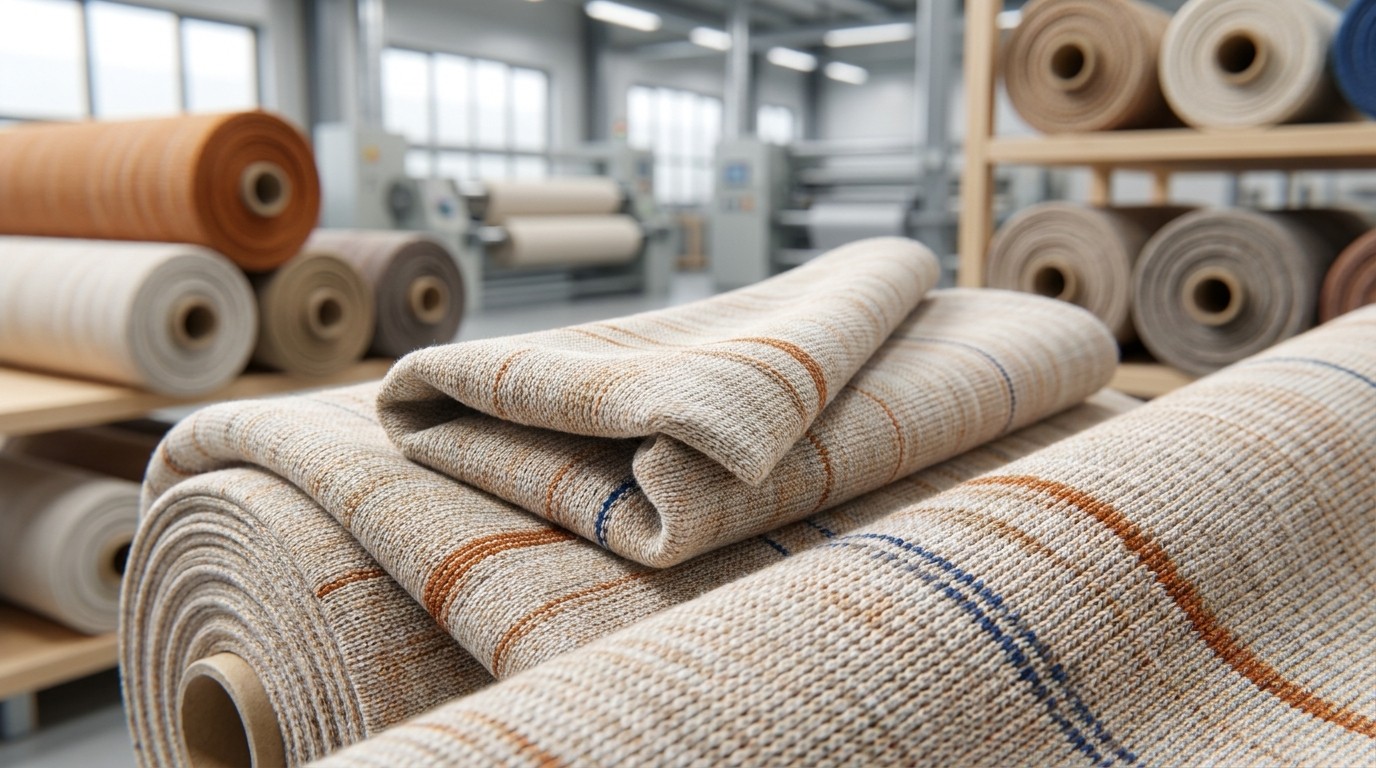
Exporting Korean recycled-polyester performance knit fabric into the EU comes down to one legal gate and one documentation chain. The legal gate is REACH, which sets the chemical limits every fabric must meet — recycled fibre included. The documentation chain is what your EU buyer needs to label the fabric, claim its recycled content, and clear customs: OEKO-TEX evidence, GRS chain-of-custody certificates, a correct fibre-composition label under Regulation (EU) No 1007/2011, and an EU-Korea FTA origin declaration on the invoice. This guide walks through each step from the mill to EU customs.
REACH Is the Legal Gate — and Recycled Does Not Mean Exempt
REACH (Regulation (EC) No 1907/2006) is the chemical law that controls what can be placed on the EU market. It is not a certificate you buy; it is a standard your fabric has to meet. The most common mistake on recycled fabric is assuming "recycled" earns lighter chemical scrutiny — it does not.
According to the European Chemicals Agency (ECHA), REACH makes no distinction between virgin and recycled fibres. Recycled feedstock can carry legacy restricted substances from its first life, so the same Substances of Very High Concern (SVHC) and Annex XVII limits apply to recycled-polyester fabric — and in practice that can mean more testing, not less.
REACH controls your 88% recycled polyester / 12% spandex knit two ways: through the SVHC Candidate List, which carries a supply-chain communication duty, and through Annex XVII, which sets hard limits on specific restricted substances.
Recycled does not mean exempt
REACH makes no distinction between virgin and recycled fibre
Per ECHA, REACH applies the same SVHC and Annex XVII limits to recycled-polyester fabric as to virgin fabric. Recycled feedstock can carry legacy restricted substances, so it can need more chemical scrutiny, not less.
The SVHC Communication Duty Under Article 33
Per ECHA, when a substance on the SVHC Candidate List is present in an article above a concentration of 0.1% weight by weight (w/w), the supplier must give recipients enough information for safe use — at a minimum, the name of the substance — and consumers who request it must receive the same within 45 days. This is REACH Article 33.
A second layer applies above that 0.1% w/w threshold. Per ECHA, EU/EEA producers or importers must notify ECHA under REACH Article 7(2) when an SVHC exceeds 0.1% w/w and the total quantity exceeds one tonne per producer or importer per year. Separately, since 5 January 2021, suppliers placing such articles on the EU market must submit data to ECHA's SCIP database, established under the Waste Framework Directive (2008/98/EC). Because the Candidate List is updated roughly twice a year, a current SVHC screening report from the mill is what lets your EU buyer answer Article 33 requests without delay.
The Restricted Substances Your Knit Fabric Must Pass
Annex XVII of REACH sets the specific limits a textile lab checks against. Two entries matter most for a recycled-polyester stretch knit.
Nonylphenol ethoxylates (NPE), entry 46a. Per Commission Regulation (EU) 2016/26, which introduced REACH Annex XVII entry 46a, textile articles that can reasonably be expected to be washed in water during normal use may not be placed on the EU market from 3 February 2021 if they contain NPE at 0.01% by weight or more — that is 100 mg/kg — of the article or any part of it. This applies to products with at least 80% textile fibres, which covers apparel fabric. NPE and the related APEO group are classic textile processing residues, so this is a standard test-report line item.
Formaldehyde and CMR substances, entry 72. Per SATRA Technology, summarizing Commission Regulation (EU) 2018/1513, REACH Annex XVII entry 72 restricts 33 carcinogenic, mutagenic or reprotoxic (CMR category 1A/1B) substances in clothing, accessories, skin-contact textiles and footwear, applicable from 1 November 2020. For formaldehyde, the maximum permitted concentration in the covered textiles is 75 mg/kg. A performance knit worn against the skin sits squarely inside entry 72's scope, so your buyer will expect a test report covering NPE and formaldehyde at these limits alongside the SVHC screening.
OEKO-TEX Standard 100 vs REACH: The Evidence Versus the Law
Buyers often ask whether OEKO-TEX Standard 100 is legally required to sell fabric in the EU. It is not.
Per OEKO-TEX, Standard 100 is an independent, voluntary certification system in which every component of a textile article — every thread, button and accessory — is tested against a list of over 1,000 regulated and potentially harmful substances. Its limit values are reviewed at least once a year and address compliance with global regulations including REACH Annexes XVII and XIV and the ECHA SVHC Candidate List, while also covering substances not yet legally regulated.
So the relationship is simple: REACH is the law you must meet; OEKO-TEX is documented evidence that you meet — and often exceed — those limits. It does not replace REACH, and REACH does not require it, but it speeds a buyer's due diligence by bundling the chemical evidence into one recognized document. Your fabric is OEKO-TEX Standard 100 tested, the evidence most EU activewear buyers ask for early.
OEKO-TEX Standard 100 vs REACH legal scope
| REACH (EC No 1907/2006) | OEKO-TEX Standard 100 | |
|---|---|---|
| Legal status in EU | Mandatory law; gate to the market | Voluntary certification; not legally required |
| What it controls | SVHC Candidate List + Annex XVII restrictions (e.g. NPE, formaldehyde) | Over 1,000 regulated and potentially harmful substances |
| Role for the exporter | Compliance you must meet to place fabric on the market | Documented evidence that the fabric meets or exceeds REACH limits |
| Update cadence | Candidate List updated about twice a year | Limit values reviewed at least once a year |
GRS Chain of Custody: The Paper Trail Behind a Recycled Claim
A recycled-content claim is only as strong as the paper trail behind it — that is where the Global Recycled Standard (GRS) does its work.
Per Textile Exchange, which owns the standard, GRS is a voluntary full-product standard for third-party certification of recycled content, chain of custody, social and environmental practices, and chemical restrictions. A product must contain at least 20% recycled material to be GRS-certified for business-to-business transactions, and at least 50% for consumer-facing GRS labelling. Your 88% recycled-polyester fabric clears both thresholds. Chain of custody is maintained through the Content Claim Standard (CCS) and verified with two documents: a Scope Certificate, proving an operation is certified, and a Transaction Certificate, verifying that the specific shipped goods conform.
This matters more from 2026. Per EUR-Lex, Directive (EU) 2024/825 — "Empowering consumers for the green transition," adopted 28 February 2024 — must be applied by Member States from 27 September 2026. It bans generic environmental claims unless excellent environmental performance is demonstrated, and prohibits sustainability labels not based on a certification scheme or established by public authorities. That makes third-party certification such as GRS directly relevant to substantiating a recycled claim — and a per-shipment Transaction Certificate is what lets your buyer keep making it.
GRS chain of custody, mill to EU buyer
- 1
Scope Certificate
Proves the Korean mill is a GRS-certified operation for the certified product.
- 2
Content Claim Standard (CCS)
The framework that tracks recycled material through each processing step.
- 3
Transaction Certificate
Verifies that the specific shipped goods conform to GRS for that order.
- 4
EU buyer's green claim
Buyer uses the certified chain to substantiate a recycled-content claim to consumers.
Fibre-Composition Labelling Under Regulation (EU) No 1007/2011
Even fully compliant fabric can be stopped over its label. Per EUR-Lex, under Regulation (EU) No 1007/2011 textile products may only be made available on the market if they are labelled, marked or accompanied with compliant commercial documents (Article 4), and must indicate fibre composition whenever made available (Article 14(1)), with the label durable, easily legible, visible, accessible and securely attached.
The composition has rules. Per EUR-Lex, only the textile fibre names listed in Annex I may be used (Article 5(1)), and a product must show the name and percentage by weight of all constituent fibres in descending order (Article 9(1)) — so list the recycled polyester and spandex by their Annex I names, by weight, highest first. The Regulation applies to products at least 80% textile fibres by weight (Article 2(2)) and allows tolerances: up to 2% extraneous fibres may be left undisclosed where technically unavoidable (5% for carded products), and a manufacturing tolerance of up to 3% between stated and analysed composition (Article 20).
On responsibility and language, Per EUR-Lex, the manufacturer must ensure the label is supplied and accurate; where the manufacturer is not established in the Union, the importer assumes that responsibility (Article 15), and the label must be in the official language(s) of the Member State where the product reaches the consumer (Article 16(3)). For a Korean mill, the legal label duty falls on the EU importer — but giving them accurate Annex I composition data up front keeps the label correct.
The EU-Korea FTA: Claim Your Duty Preference With the Right Document
Here a well-known competitor error costs exporters money. Under the EU-South Korea Free Trade Agreement, preferential origin is not proven with an EUR.1 certificate. It is proven with an origin declaration on the invoice.
Per the European Commission's Access2Markets, products originating in the EU or South Korea can benefit from reduced or zero preferential customs duties, and exporters prove preferential origin with an origin declaration entered on the invoice or another commercial document — there is no separate certificate. For consignments with a total value of EUR 6,000 or more, the declaration may only be made out by an "approved exporter" authorised by customs. Goods must meet the FTA's product-specific rules of origin, with specific rules and tolerances for textiles and clothing (Harmonized System Chapters 50-63). An EUR.1 form is the wrong instrument here, and relying on it can mean your buyer pays full duty.
On classification: Per the European Commission's Taxation and Customs Union, knitted fabrics over 30 cm wide containing 5% or more of elastomeric yarn (other than heading 6001) fall under heading 6004, and CN subheading 6004 10 00 covers such fabrics with 5% or more elastomeric yarn but no rubber thread. The first six digits are the WCO HS code; the EU extends this to 8-digit CN codes for export declarations and 10-digit TARIC codes for import declarations. Confirm the exact duty and preferential rate in the official EU TARIC database for the precise code and origin — that figure depends on the live code and date and should be checked there, not assumed.
The Document Package From the Korean Mill to EU Customs
Pull the threads together and the order's paperwork is predictable. At order and at customs clearance, an EU activewear buyer expects: REACH test reports covering the SVHC 0.1% w/w trigger, NPE at 100 mg/kg and formaldehyde at 75 mg/kg; an OEKO-TEX Standard 100 certificate as bundled chemical evidence; a GRS Scope Certificate plus a Transaction Certificate for the shipment if a recycled claim will be made; accurate Annex I fibre-composition data for the label; and an EU-Korea FTA origin declaration on the invoice, with approved-exporter status for consignments of EUR 6,000 or more.
Get that set right and it clears every repeat order. Get one piece wrong — an outdated SVHC report, a missing Transaction Certificate, an EUR.1 form instead of an invoice declaration, or a fibre name not on Annex I — and the shipment can be held, the duty preference lost, or the recycled claim left unsupportable at the EU border. Where an export-ready supplier helps is in having that chain built before the order ships, instead of assembling it under port pressure. Peakstone Export's recycled-polyester performance knit is OEKO-TEX Standard 100 tested and made from GRS-certified recycled polyester at an ISO 9001 mill that is a bluesign system partner, and as your trade partner we line up the set these rules call for so your EU buyer can clear customs and substantiate a recycled claim without rebuilding the file at the border.
EU documentation package from the Korean mill
- REACH test reportsCover SVHC (0.1% w/w), NPE (100 mg/kg) and formaldehyde (75 mg/kg) limits.
- OEKO-TEX Standard 100 certificateOptional but widely requested as documented chemical evidence.
- GRS Scope + Transaction CertificateNeeded if the EU buyer makes a recycled-content claim.
- Fibre-composition label dataAnnex I fibre names, percentage by weight, descending order.
- EU-Korea FTA origin declarationOn the invoice; approved exporter for consignments of EUR 6,000 or more.
- Correct CN / TARIC codeHeading 6004 for the elastomeric stretch knit; confirm duty in TARIC.
Last updated: 2026-06. This guide is for general information only. EU import and chemical rules change and can depend on your specific product and shipment. Confirm current requirements with ECHA, the European Commission, your testing laboratory, and a qualified customs, regulatory, or labelling professional before you ship.
Frequently Asked Questions
- Does our recycled-polyester knit fabric still have to comply with REACH, or do recycled fibres get an exemption?
- It must comply, with no exemption. Per ECHA, REACH makes no distinction between virgin and recycled fibres, so the same SVHC and Annex XVII limits apply. Because recycled feedstock can carry legacy restricted substances, it can warrant closer scrutiny, not less — plan for the same test set as virgin fabric.
- Is OEKO-TEX Standard 100 legally required to sell fabric in the EU, and how does it relate to REACH?
- No, it is voluntary. REACH is the law you must meet; OEKO-TEX is documented evidence that you meet it. Per OEKO-TEX, Standard 100 tests every component against over 1,000 substances and addresses compliance with REACH Annexes XVII and XIV and the ECHA SVHC Candidate List. A fabric can be REACH-compliant without it, but many EU buyers ask for it as bundled evidence.
- Which REACH-restricted substances must our knit fabric pass, and what are the exact limits?
- The two top items are NPE and formaldehyde. Per Commission Regulation (EU) 2016/26 (REACH Annex XVII entry 46a), washable textiles may not be placed on the EU market from 3 February 2021 with NPE at 0.01% by weight or more (100 mg/kg). Per SATRA Technology, summarizing Commission Regulation (EU) 2018/1513 (entry 72), the formaldehyde limit in skin-contact textiles is 75 mg/kg from 1 November 2020. The SVHC Article 33 duty also applies above 0.1% w/w.
- What GRS documents does our EU buyer need to make a "recycled" claim?
- A Scope Certificate and a Transaction Certificate. Per Textile Exchange, the Scope Certificate proves the operation is GRS-certified and the Transaction Certificate verifies the specific shipped goods conform. GRS requires at least 20% recycled content for B2B certification and 50% for consumer labelling. Per EUR-Lex, Directive (EU) 2024/825 applies from 27 September 2026 and prohibits sustainability labels not based on a certification scheme, so a per-shipment Transaction Certificate keeps the claim defensible.
- How do we prove EU-Korea FTA origin — is it an EUR.1 certificate?
- No. Per the European Commission's Access2Markets, the EU-Korea FTA proves preferential origin with an origin declaration entered on the invoice or another commercial document — no separate certificate. For consignments of EUR 6,000 or more, only an "approved exporter" authorised by customs may make it out, and the goods must meet the FTA's textile rules of origin (HS Chapters 50-63). An EUR.1 form is the wrong instrument and can cost your buyer the duty preference.
This information is provided for reference. Always confirm current requirements with ECHA, the European Commission, your testing laboratory, and qualified customs, regulatory, or labelling experts before you ship.
References
- EUR-Lex — Regulation (EU) No 1007/2011 (textile fibre names and fibre-composition labelling)
- EUR-Lex — Commission Regulation (EU) 2016/26 (REACH Annex XVII entry 46a, NPE in textiles)
- SATRA Technology — REACH Annex XVII entry 72 (CMR substances; formaldehyde 75 mg/kg)
- ECHA — Communication in the supply chain (REACH Article 33, SVHC 0.1% w/w)
- ECHA — SCIP database (Article 7(2) notification, Waste Framework Directive 2008/98/EC)
- OEKO-TEX — Standard 100 (voluntary harmful-substance certification)
- Textile Exchange — Global Recycled Standard (GRS) and chain of custody
- European Commission (Access2Markets) — EU-South Korea Free Trade Agreement (origin declaration)
- EUR-Lex — Directive (EU) 2024/825 (Empowering consumers for the green transition)
- European Commission (Taxation and Customs Union) — EU Customs Tariff / TARIC (CN heading 6004)