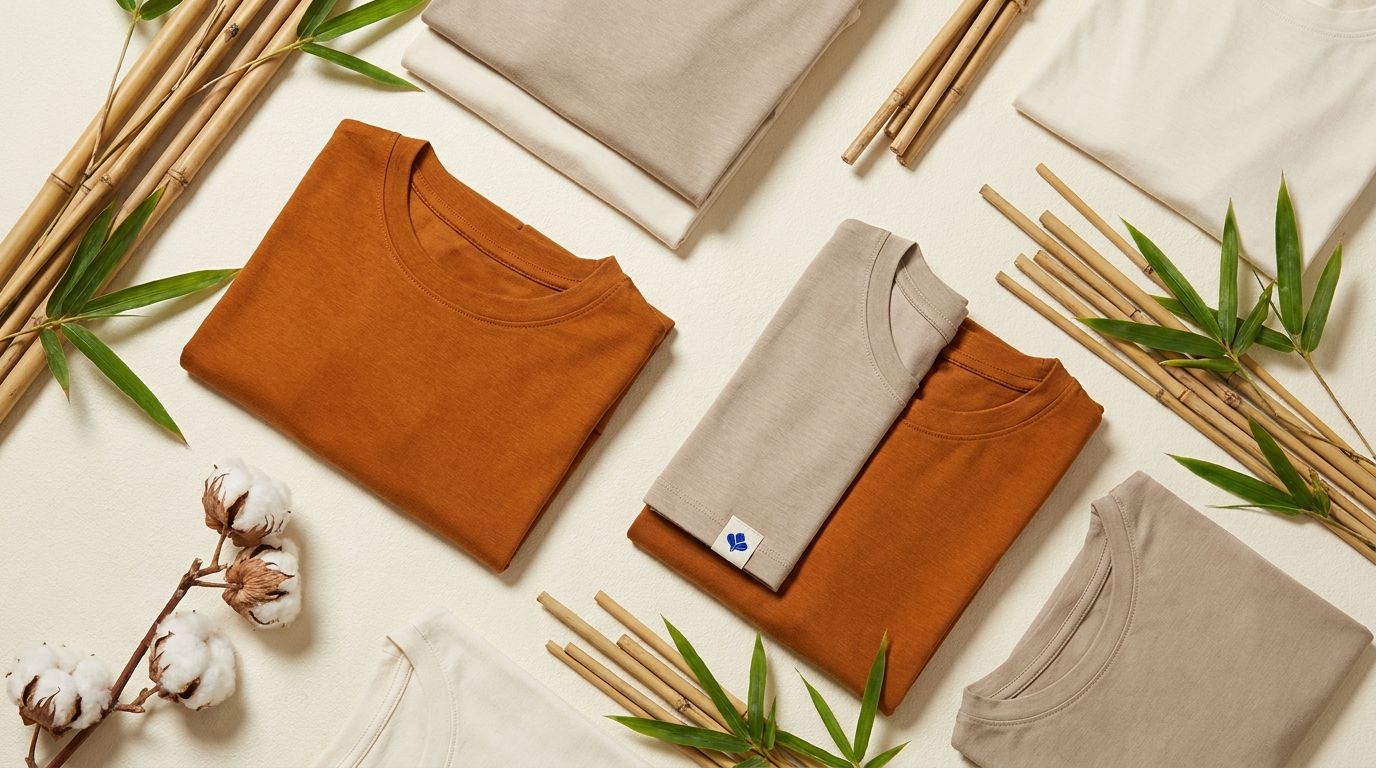
Canada's sustainable fabrics market was valued at USD 2,619.2 million in 2024 and is growing at a 12.5% annual rate through 2035, per Market Research Future, with apparel as the dominant segment. A 70% bamboo viscose / 30% organic cotton 180gsm t-shirt with OEKO-TEX Standard 100 certification sits precisely where Canadian category managers are building new lines — above commodity basics, below premium alternatives, with a tariff cost advantage for Korean-origin supply under the Canada-Korea Free Trade Agreement. This guide covers the market size, demand drivers, active buyer channels, competitive positioning, labeling rules, and tariff considerations a sourcing or category manager needs to build an internal business case for adding a Korean bamboo-blend supplier.
Canada's Sustainable Apparel Market: Size and Growth Trajectory
According to Market Research Future, Canada's sustainable fabrics market was valued at USD 2,619.2 million in 2024 and is projected to reach USD 9,570.4 million by 2035, growing at a compound annual growth rate of 12.5% from 2025 to 2035. The clothing and apparel segment is dominant within this market, with organic and natural-fiber materials holding the largest sub-segment share.
Within the broader basics category, Grand View Research reports that Canada's blank apparel and basics market — where t-shirts compete — generated USD 202.2 million in 2024. T-shirts and tanks account for 48.32% of that segment's revenue and are projected to grow at a 4.6% CAGR through 2033.
These two figures frame the addressable opportunity: a large, fast-growing certified sustainable fabrics layer sits on top of a stable and substantial basics category. Bamboo-blend basics sit at the intersection of both.
Per Maximize Market Research, the global bamboo clothing market was valued at USD 2.17 billion in 2025 and is projected to grow at a CAGR of 8.5% through 2032. The t-shirt segment holds the largest product share within bamboo clothing, and North America leads in market share.
What Is Driving Demand for Eco Basics in Canada
Three demand forces are running together.
Consumer willingness to pay is real, with a notable gap to close. According to PwC's 2024 Voice of the Consumer Survey, global consumers are willing to pay an average of 9.7% more for sustainably produced or sourced goods — even amid ongoing cost-of-living pressures. Industry-level data indicates consumers accept 20–40% price premiums for verified sustainable bamboo-blend performance attributes, and OEKO-TEX and GOTS certifications individually command an additional 8–20% retail price premium, per Szonier Fabrics (industry trade publisher).
The caveat is real. Per a July 2024 survey of 1,508 Canadian consumers by Public Inc and Ipsos Canada, 76% of Canadians self-identify as conscious shoppers, but only 38% of their actual purchases reflect sustainability values. Affordability and skepticism about greenwashing claims are the primary barriers. Category managers should size the addressable buyer segment as the certified-and-verifiable segment, not the full market.
Retailer ESG and responsible-sourcing commitments are adding structural demand. Canadian eco specialty, outdoor, and mid-market retailers are broadening supplier screening criteria to include fiber and chemical safety certifications. The OEKO-TEX Association notes that over 35,000 companies worldwide hold valid OEKO-TEX certificates — a widely recognized signal among buyers evaluating textile suppliers. This has made OEKO-TEX Standard 100 a practical prerequisite in many eco specialty and private-label vendor onboarding processes.
Enforcement tailwinds reinforce the value of certified supply. Per SGS Group (citing U.S. FTC enforcement data), the FTC's Bamboo Textile Enforcement Program has levied over USD 3.1 million in fines since 2021 against companies mislabeling viscose rayon as "bamboo fiber." Canada's Competition Bureau bamboo-labeling guidance explicitly tracks FTC standards. Buyers sourcing from certified suppliers with compliant labeling are insulated from this enforcement risk.
Where a 70% Bamboo Viscose / 30% Organic Cotton T-Shirt Fits the Market
North American bamboo fabric demand is growing at approximately 9% year-over-year (2024–2025), primarily in activewear and wellness segments, per Szonier Fabrics.
A 70% bamboo viscose / 30% organic cotton 180gsm construction addresses several market requirements at once. The weight is appropriate for year-round basics and light activewear. The antibacterial and odor-control properties are relevant to wellness, travel, and outdoor applications. The biodegradable composition is supported by OEKO-TEX Standard 100 certification on the fabric. The size range (XS–3XL) spans retail and uniform channels.
Per the OEKO-TEX Association, OEKO-TEX Standard 100 tests textile products against over 1,000 harmful substances across all garment components — fabric, thread, buttons, and labels. Class 2 applies specifically to products worn in direct skin contact, which includes t-shirts. The standard is not legally required in Canada but is widely used by eco specialty retailers, private-label programs, and online marketplaces as a vendor onboarding criterion.
Active Buyer Channels for Sustainable Basics
Four Canadian buyer channels are currently active for certified eco basics.
Eco specialty retailers (specialty boutique networks, certified sustainable fashion brands such as Encircled and Free Label) are the highest-certification-intensity channel. OEKO-TEX Standard 100 and organic-content claims are effectively mandatory for vendor approval. Order volumes are smaller but price tolerance is highest.
Outdoor and performance retailers (Mountain Equipment Company, specialty outdoor chains) are expanding sustainable-basics lines. Bamboo-blend construction appeals because the odor-control and moisture-management performance attributes can be substantiated with certification, not just marketing language.
Private-label apparel programs across department-store and mid-market retail represent the largest single volume opportunity. Category managers building or refreshing a private-label basics program evaluate bamboo-cotton blends as a positioned-above-commodity alternative with a defensible sustainability story. MOQ for OEM private-label programs from a Korean manufacturer is typically 500 pcs per colorway / 1,000 pcs per order — workable for initial range testing.
Uniform and promotional-wear distributors are an underserved channel for certified bamboo basics. Corporate buyers sourcing sustainable branded garments for ESG-aligned companies are a growing segment. Price sensitivity is moderate, certification expectations are rising, and order cadence is predictable.
The Competitive Landscape: Bamboo vs. Recycled Polyester vs. Organic Cotton
Category managers evaluating bamboo basics compare primarily against recycled polyester and organic cotton, not conventional cotton (which is being phased out of sustainable sourcing programs).
Bamboo-cotton blends carry a natural-fiber comfort story that recycled polyester cannot match — softness, breathability, and skin contact suitability (OEKO-TEX Class 2, direct skin contact). Recycled polyester carries a microplastic concern in sustainability conversations, particularly for consumers and buyers following ocean-plastics discourse.
Against organic cotton, bamboo blends compete on functional differentiation. The antibacterial and odor-control attributes give category managers a performance reason to range the product alongside an existing organic-cotton line rather than replacing it. One important distinction: GOTS certification requires the fiber itself to be organic, which viscose-from-bamboo cannot meet because the viscose process is chemical, not mechanical. Buyers who need full GOTS coverage will need an organic-cotton line; buyers looking for certified safe-for-skin basics with a sustainable-fiber performance story will find bamboo-cotton a fit for their range.
Bamboo-Cotton Blend vs. Organic Cotton: Canadian Buyer Comparison
| Bamboo-Cotton Blend (viscose) | Organic Cotton | |
|---|---|---|
| Key eco certification | OEKO-TEX Standard 100 (Class 2) | GOTS / OCS / OEKO-TEX Standard 100 |
| Antibacterial claim | Yes (bamboo viscose finish) | No |
| Microplastic concern | None (natural fiber) | None |
| GOTS-eligible | No (chemical viscose process) | Yes |
| Retail price premium potential | 8–20% with OEKO-TEX (Szonier Fabrics) | 10–25% with GOTS |
| Primary channel fit | Performance, wellness, uniform, promo | Eco specialty, organic heritage brands |
Canada's Labeling Rule: What Must Appear on Every Garment
This is the compliance point that trips most sourcing programs. Canada's Competition Bureau requires bamboo-derived viscose textiles to be labeled "viscose from bamboo" or "rayon from bamboo" on care labels and hang tags. Per Competition Bureau Canada guidance under the Textile Labelling Act, using "bamboo" alone as a generic fiber name is prohibited unless the fiber is mechanically processed directly from bamboo. Marketing terms such as "all-natural bamboo" are treated as misleading under the Competition Act.
Acceptable terms include: rayon, viscose, rayon from bamboo, viscose from bamboo, modal rayon, and lyocell.
For a 70% bamboo viscose / 30% organic cotton product, the care label and fiber content hang tag must read "70% viscose from bamboo / 30% organic cotton" or "70% rayon from bamboo / 30% organic cotton." The importer bears the enforcement risk, not the manufacturer. B2B spec sheets, catalog listings, and purchase order language should use the same compliant terminology. Suppliers whose factory default labels read "bamboo fiber" are passing labeling risk to the Canadian buyer.
Label Compliance: What Every Canadian Shipment Must Say
Competition Bureau Canada: 'Bamboo' alone is not a valid fiber name on labels
Per Competition Bureau Canada guidance under the Textile Labelling Act, bamboo-derived viscose must be labeled 'viscose from bamboo' or 'rayon from bamboo'. Korean factory labels that read 'bamboo fiber' or 'bamboo' are non-compliant for Canadian shipments. The importer — not the manufacturer — bears the enforcement risk. Marketing terms such as 'all-natural bamboo' are treated as misleading under the Competition Act.
Tariff Advantage for Korean Suppliers Under CKFTA
Korean-origin apparel qualifies for preferential duty treatment under the Canada-Korea Free Trade Agreement (CKFTA), which entered into force on January 1, 2015. Per Global Affairs Canada (citing CKFTA documentation), Canada has staged out tariffs on 97.8% of its tariff lines for goods imported from South Korea.
Standard MFN (Most Favoured Nation) apparel import duties in Canada typically run 17–18% for most garment categories, per BorderBuddy (Canadian licensed customs broker). CKFTA preferential rates materially reduce this cost, improving the landed-cost position for Korean supply relative to non-FTA Asian sourcing alternatives.
A Certificate of Origin (Form KOR or equivalent) must accompany each commercial shipment to claim the CKFTA preferential rate. Category managers building a landed-cost model for a Korean bamboo-cotton tee should include this differential against a non-FTA origin. For an ex-factory FOB unit at standard apparel pricing, a 17–18% tariff differential is a meaningful landed-cost variable.
Canadian Buyer Due Diligence Checklist: Onboarding a Korean Bamboo-Cotton Supplier
- Verify OEKO-TEX Standard 100 certificate scopeConfirm validity date and that the specific blend (70% viscose from bamboo / 30% organic cotton, 180gsm) is explicitly covered by the certificate.
- Confirm compliant Canadian labelingCare labels and hang tags must read 'viscose from bamboo' or 'rayon from bamboo'. Request custom labeling before production begins.
- Obtain CKFTA Certificate of OriginForm KOR or equivalent required at customs to claim preferential duty rates and avoid the standard 17–18% MFN tariff.
- Align order timing with the seasonal calendarSpring/summer delivery requires Q4 of the prior year order placement. Confirm production lead time before committing to a range date.
- Request production capacity and MOQ in writingConfirm 500 pcs per colorway / 1,000 pcs minimum order / monthly capacity before signing a purchase order.
Seasonality, Ordering Calendar, and Price Positioning
Canadian wholesale buyers for t-shirts and basics place spring/summer orders in Q4 of the preceding year to ensure delivery ahead of peak selling season (May–August), per eFulfillment Service (North American e-commerce logistics provider). T-shirts are the summer-dominant SKU with the highest sell-through velocity during warmer months.
For a Korean OEM supplier, allow 90–120 days from purchase order confirmation to Canadian port delivery. Category managers evaluating a Korean bamboo-cotton basics program for a 2027 spring/summer range should begin supplier qualification in early to mid-2026.
Certified sustainable basics for wellness, uniform, and promotional channels carry more year-round sell-through, which supports a more consistent order cadence outside the peak summer window.
On price positioning: a 180gsm bamboo-cotton blend with OEKO-TEX Standard 100 certification should be priced above commodity basics and positioned as a certified sustainable option with functional differentiation. The 8–20% retail premium that OEKO-TEX certification supports (per Szonier Fabrics) gives category managers room to price above commodity without leaving the mid-market buyer.
Last updated: 2026-06. This guide is for general information and reference only. Market data, certification requirements, labeling rules, and trade agreement terms change and depend on your specific product, channel, and shipment. Always confirm current requirements with Statistics Canada, Competition Bureau Canada, the Canada Border Services Agency, the OEKO-TEX Association, and qualified legal, customs, or compliance professionals before placing production orders.
Frequently Asked Questions
- What certifications do Canadian eco or outdoor retailers typically screen for from a Korean bamboo t-shirt supplier?
- OEKO-TEX Standard 100 (Class 2 for direct skin contact) is the most widely screened certification, per the OEKO-TEX Association, covering 1,000+ harmful substances across all garment components. Eco specialty retailers may additionally require organic-content claims such as GOTS (for organic-cotton lines) or OCS (Organic Content Standard for blends). Buyers in the outdoor and performance channel may also screen for social compliance audits (WRAP, BSCI).
- How does Canada's labeling requirement for bamboo-derived apparel differ from what Korean factory labels typically say?
- Per Competition Bureau Canada, "viscose from bamboo" or "rayon from bamboo" is required on Canadian care labels and hang tags — not "bamboo fiber" or "bamboo." Most Korean factory default labels use "bamboo fiber" for exports to other markets. Canadian buyers must specify compliant label copy before production begins; the importer bears enforcement liability if the label is non-compliant at Canadian customs.
- What is a realistic MOQ, lead time, and FOB price range from a Korean OEM supplier for a 180gsm bamboo-cotton private-label tee?
- For a Korean OEM program, minimum order quantity is typically 500 pcs per colorway (1,000 pcs minimum per order), with monthly production capacity of 50,000 pcs. Production and shipping lead time from Korea to Canada runs approximately 90–120 days. CKFTA preferential duty rates improve Canadian landed cost relative to non-FTA sourcing alternatives when a Certificate of Origin is supplied.
- Does a 70% bamboo viscose / 30% organic cotton tee qualify for GOTS certification?
- No. GOTS (Global Organic Textile Standard) requires the fiber content to meet organic fiber standards throughout the supply chain. Bamboo viscose is produced through a chemical process (not mechanical extraction), so it does not qualify as an organic fiber under GOTS. An OEKO-TEX Standard 100 certificate is the appropriate chemical-safety certification for this blend and covers direct skin contact requirements under Class 2. Buyers who need GOTS coverage should source an organic-cotton line alongside a bamboo-blend line.
- What due diligence should a Canadian importer take to verify OEKO-TEX Standard 100 certification authenticity before placing a production order?
- Per the OEKO-TEX Association, every valid OEKO-TEX Standard 100 certificate can be verified through the OEKO-TEX label check database at oeko-tex.com. Buyers should confirm the certificate number, the named facility, the validity period (certificates require annual renewal), and that the specific fabric composition (70% bamboo viscose / 30% organic cotton, 180gsm) is listed within the certificate scope. A certificate that covers a different blend or weight is not valid for the product being ordered.
This information is provided for reference. Always confirm current requirements with Statistics Canada, Competition Bureau Canada, the Canada Border Services Agency, the OEKO-TEX Association, and qualified legal, customs, or compliance professionals before placing production orders.
References
- Market Research Future — Canada sustainable fabrics market size USD 2,619.2M in 2024, projected USD 9,570.4M by 2035, 12.5% CAGR (2025–2035); clothing/apparel dominant segment
- Grand View Research — Canada blank apparel and basics market USD 202.2M in 2024; t-shirts/tanks 48.32% revenue share; 4.6% CAGR through 2033
- Maximize Market Research — Global bamboo clothing market USD 2.17B in 2025; 8.5% CAGR through 2032; t-shirt segment largest; North America leads market share
- PwC 2024 Voice of the Consumer Survey — global consumers willing to pay average 9.7% more for sustainably produced or sourced goods
- Fibre2Fashion (citing Public Inc / Ipsos Canada, July 2024) — 76% of Canadians self-identify as conscious shoppers; only 38% of actual purchases reflect sustainability values
- OEKO-TEX Association — OEKO-TEX Standard 100: tests against 1,000+ harmful substances; Class 2 for direct skin contact (t-shirts); 35,000+ companies worldwide; aligns with REACH, CPSIA, ECHA-SVHC
- Szonier Fabrics — North American bamboo fabric demand growing ~9% YoY (2024–2025); OEKO-TEX/GOTS certifications command 8–20% retail price premium; bamboo-cotton blends dominate mainstream apparel
- SGS Group (citing U.S. FTC) — FTC Bamboo Textile Enforcement Program: USD 3.1M+ in fines since 2021 for mislabeling viscose rayon as bamboo fiber
- Competition Bureau Canada — Textile Labelling Act guidance: bamboo-derived viscose must be labeled "viscose from bamboo" or "rayon from bamboo"; "bamboo" alone prohibited; "all-natural bamboo" treated as misleading
- Global Affairs Canada — Canada-Korea Free Trade Agreement (CKFTA): in force January 1, 2015; Canada eliminated/staging out tariffs on 97.8% of Korean goods; Certificate of Origin required for preferential rates
- BorderBuddy (Canadian licensed customs broker) — Standard MFN apparel import duties in Canada typically 17–18%; CKFTA preferential rates reduce cost for Korean-origin supply
- eFulfillment Service — Canadian apparel seasonality: spring/summer orders placed Q4 prior year; t-shirts summer-dominant SKU with highest sell-through velocity May–August